
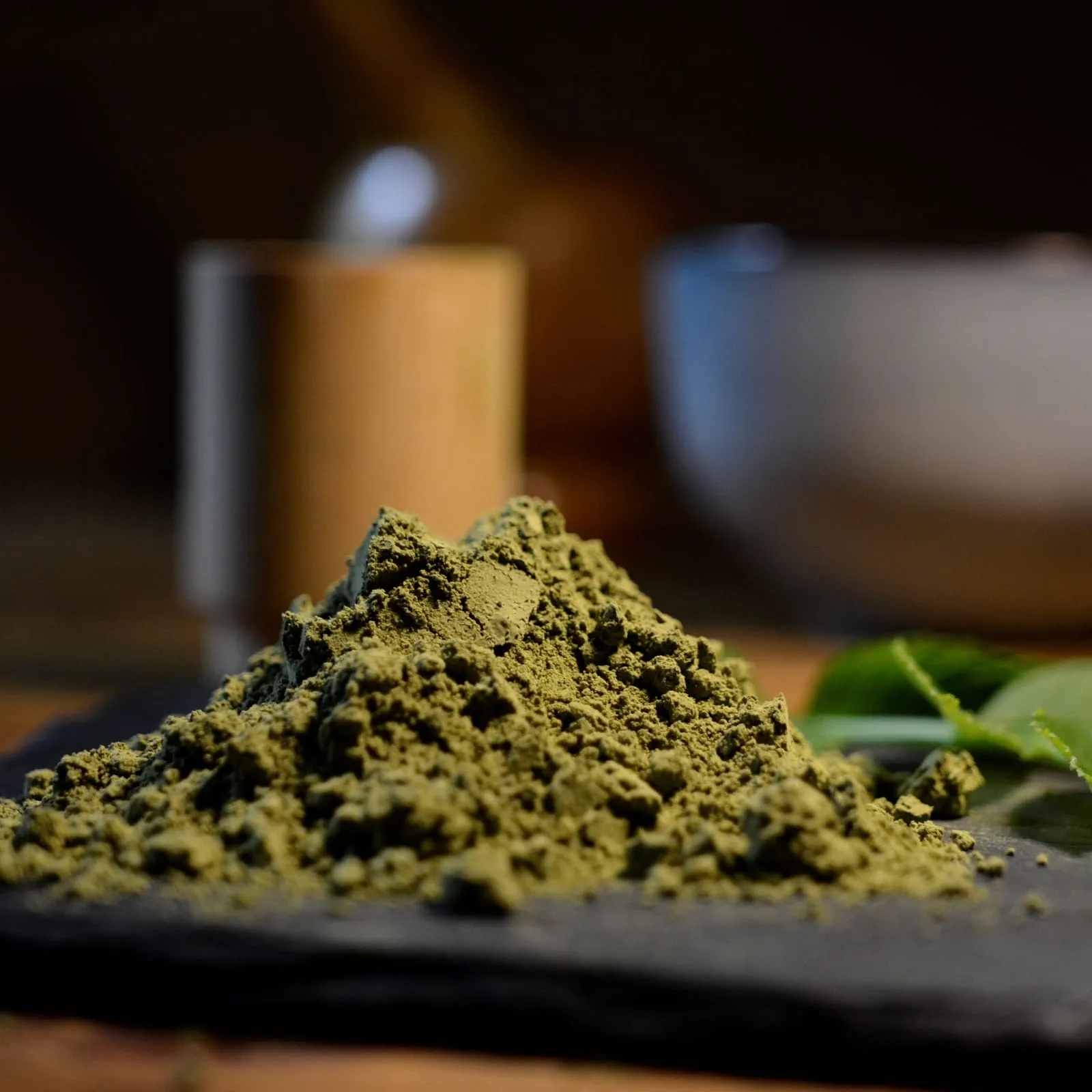
A heavy metal test tells you a concentration: how much of a metal sits in one gram of powder. The number that matters to a body is a daily dose, and getting from the first to the second means multiplying by the grams you take. That multiplication is the whole exercise. The same certificate can be unremarkable at 2 grams a day and above every published limit at 20.
This is not a theoretical point. A 2024 assessment in Clinical Toxicology pooled the published third-party analyses of 68 kratom products and ran them against permitted daily exposure limits at two intakes. Assuming 3 grams a day, 7.4 percent of the products exceeded the limit for lead and 3.1 percent for arsenic. At 25 grams a day, the same products and the same limits gave 70.6 percent for lead and 9.4 percent for arsenic. The products did not change. Only the assumed intake did. (That paper sits behind a paywall, so it is cited here from its published abstract, which is where those figures appear.)
So a report is not a verdict. It is one input, and you supply the other.
This page is about method: what the numbers on a certificate mean and how to work out what they amount to for you. What the testing has actually found in kratom products, across metals, microbes and alkaloid content, is a separate piece: what testing has found in kratom products.
Every unit on the page is the same number
Reports use different units for the same thing, which is the first place readers lose their footing. These are all identical:
- 1 microgram per gram (µg/g)
- 1 milligram per kilogram (mg/kg)
- 1 part per million (ppm)
- 1,000 nanograms per gram (ng/g)
The US Food and Drug Administration published its kratom results in ng/g. Academic papers generally use µg/g. European law is written in mg/kg. Before comparing anything, convert it all to one unit. Nearly every confused argument about whether a result is high comes down to a factor of a thousand.
The arithmetic
Micrograms per day equals concentration in µg/g multiplied by grams taken per day.
A result of 0.5 µg/g at 5 grams a day gives 2.5 µg a day. The 2022 Toxics review of lead in kratom products works exactly that example, and notes what it compares to: a 100 gram serving of fruit cocktail plus a 40 gram chocolate bar comes to about 1.4 µg of lead between them. A 5 gram dose of a mid-range product carries more lead than both.
Do this calculation before you look at anything else on the certificate.
Which limit you are comparing against, and why they disagree
There is no limit written for kratom anywhere in the world. Every threshold you will see quoted was set for something else, and they are not interchangeable.
Daily exposure limits, from pharmaceutical guidance. ICH Q3D, the international guideline on elemental impurities in medicines, sets oral permitted daily exposures of 5 µg a day for lead, 5 for cadmium, 15 for arsenic, 30 for mercury and 200 for nickel. Lead, cadmium, arsenic and mercury are its Class 1 elements, meaning human toxicants it expects to be controlled. Nickel is Class 2A. These are the figures most kratom lab discussions are implicitly using, and they were written for drug products.
Dietary reference levels, from the FDA. The FDA’s interim reference levels for lead in food are 2.2 µg a day for children and 8.8 µg a day for females of childbearing age. Both are derived from the CDC’s blood lead reference value of 3.5 µg per decilitre, with a tenfold safety factor built in. The FDA states plainly on the same page that “no safe level for lead exposure has been identified.”
Concentration limits, from EU law. Commission Regulation (EU) 2023/915 sets maximum levels for contaminants in food. For food supplements it allows 3.0 mg/kg of lead (entry 3.1.28), 1.0 mg/kg of cadmium (3.2.21.1, rising to 3.0 for supplements made mostly of dried seaweed or bivalve molluscs) and 0.10 mg/kg of mercury (3.3.2). It sets no supplement-specific level for inorganic arsenic.
Health-based guidance values, from EFSA. For cadmium, the European Food Safety Authority holds a tolerable weekly intake of 2.5 µg per kilogram of body weight, set in 2009 and confirmed in 2011 after comparison with the World Health Organization’s figure. For lead, EFSA went the other way. Its 2010 opinion concluded that the previous tolerable weekly intake of 25 µg/kg body weight “is no longer appropriate as there is no evidence for a threshold for critical lead-induced effects.” Instead of a safe level it published reference points, the lowest being a blood lead level of 12 µg/L, corresponding to a dietary intake of 0.50 µg/kg body weight per day, for developmental neurotoxicity in young children. EFSA added that protecting children against neurodevelopmental effects would protect everyone against lead’s other effects. (Both EFSA figures are cited here from the published abstracts of those opinions, which state the conclusions and reference points in full.)
Two regulators on two continents reached the same conclusion about lead independently, and it is the one worth carrying away: there is no threshold below which it is known to be fine.
A concentration limit and a daily limit are not the same test
This is where a report can be honestly labelled “pass” and still leave your question unanswered.
In 2019 the FDA tested 30 kratom products. Lead ran from “not detected above 200 ng/g” up to 2,700 ng/g. Convert that ceiling and it is 2.7 mg/kg, which is below the EU’s 3.0 mg/kg maximum for food supplements. On concentration alone, every product in that set would have cleared the European limit.
Now apply intake. At 5 grams a day, 2.7 µg/g gives about 13.5 µg of lead a day, against a pharmaceutical daily figure of 5 µg and an FDA reference level of 8.8 µg for females of childbearing age.
Both statements are true at once. The concentration passes and the daily exposure does not, because a concentration limit for supplements assumes you eat a modest amount of the thing. Kratom powder is measured out in grams, repeatedly, sometimes for years. If a certificate tells you it meets a food-supplement maximum level, it has answered a question about milligrams per kilogram, not about your day.
Where body weight enters
EFSA’s values are per kilogram of body weight, so they need one more step. A tolerable weekly intake of 2.5 µg/kg for cadmium works out, for a 70 kilogram adult, to 175 µg a week or about 25 µg a day. For a 50 kilogram adult it is 125 µg a week. The smaller you are, the smaller the allowance, and that allowance covers everything you eat, not one product.
“Not detected” is not the same as zero
Two terms you need. The limit of detection is the smallest amount an instrument can tell apart from nothing. The limit of quantification is the smallest amount it can put a reliable number on. Below those, the honest answer is “we could not see it here”, which is not the same as “it is not there.”
The FDA’s table is the model for how to report this. It does not print “ND”. It prints
“Not detected above 200 ng/g”, stating the threshold the result sits under. That is a
usable result. A bare “ND”, “none detected” or <LOQ with no figure attached is not a
result at all, and you cannot do the arithmetic on it.
The threshold matters more the more you take. Suppose a report’s limit of quantification for lead is 200 ng/g, or 0.2 µg/g. At 25 grams a day, a product sitting just under that threshold could still be delivering up to 5 µg of lead a day, which is the entire pharmaceutical daily figure. At that intake, a non-detect against that limit cannot tell you that you are under the line. It only tells you the lab could not see past 0.2 µg/g.
So look for the detection limit, and check it against your own intake rather than against nothing.
What the certificate does not tell you
Whether it describes the powder you have. This is the most common failure and the hardest to fix. A test applies to the batch that was tested, so a certificate is only attached to your packet if both carry the same lot or batch number. A 2025 study in the Harm Reduction Journal test-purchased 10 kratom products from vendors serving Hungary and the Czech Republic and inspected the packaging. Four carried substantive information about contents, distributor and country of origin. Two carried lot numbers. For the other eight, no certificate could have been matched to the product, whatever the certificate said.
Which elements were tested. A lead-only panel says nothing about the rest. In the FDA set, nickel ran from 576 to 29,000 ng/g. At the top of that range, 29 µg/g at 10 grams a day gives about 290 µg of nickel a day, against a permitted daily exposure of 200. Nickel was also among the highest of the toxic metals the 2020 study measured, above 2 µg/g in most of its products. A report covering four metals when the plant carries seven is a partial answer presented as a complete one.
How much the product varies inside itself. Ground leaf is not homogeneous. The FDA tested five subsamples of a single five-strain sample pack and got lead results of 460, 550, 584, 790 and 2,700 ng/g. That is a near sixfold spread within one product, and the highest value in the entire 30-product survey came from it. One number from one sample can be unrepresentative of the bag it came from.
Whether the figures are dry weight or as sold. The 2020 study reported both, and found dry-weight values consistently 10 to 15 percent higher than wet weight across every product. If the report does not say which basis it used, the number has a 15 percent question mark on it before you start.
The method and the laboratory. The published work uses inductively coupled plasma mass spectrometry (ICP-MS), which measures elements directly after the sample is digested in acid. If a report does not name its method, you cannot judge it.
Leaf and extract are not the same material
The 2020 study tested eight products: six of ground leaf, one semi-processed and one a concentrated alkaloid extract. Every one carried measurable metals except the concentrated extract, and the authors concluded that the extraction process appears to remove them. The 2024 pooled assessment found the same pattern across a larger set: non-extract products (powders, capsules, tablets) generally contained higher concentrations than extracts. In the FDA’s data, the two products reported as “not detected above 200 ng/g” for lead were both liquid preparations.
Read that as chemistry, not as a shopping rule. Extracts concentrate alkaloids as well, so grams of extract and grams of leaf are not comparable quantities, and the daily arithmetic above does not carry across between them. Concentrated products bring their own set of questions that a metals panel does not address.
Nothing here was written for kratom
The EU maximum levels apply to food supplements. Whether a given kratom packet is legally a food supplement is a separate question, and in the European sample above, mostly it was not sold as one: 80 percent of the 25 shops examined carried disclaimers, and of those, 80 percent described the product as for “botanical” or “analytical purposes” and 75 percent said it was not suitable for human consumption. A product sold on that basis sits outside the category those maximum levels govern.
The pharmaceutical figures were not written for it either. ICH Q3D is guidance for medicines, where a manufacturer controls the whole process.
Which means that when a kratom report carries a pass or a fail, somebody chose the limit it was judged against. Finding out which one is the first thing to do, not the last.
What is still unknown
Where the lead comes from has not been established. The 2022 review sets out the candidates, soil and water uptake in growing regions and contamination from grinding, processing and storage equipment, and says outright that studies to identify the source are needed. It notes that over 90 percent of the kratom sold in the United States comes from Indonesia, where some volcanic soils carry high metal levels and lead pollution is documented, but no one has traced a batch from soil to market.
The evidence base is also small. Eight products in the 2020 study, 30 in the FDA’s, 68 pooled in 2024. Whether those findings generalise to the products on sale now, in Europe, years later, is not known.
And nothing here tells you what any of it did to a particular person. The metals arithmetic gives an exposure estimate, not a diagnosis. Blood lead is a routine measurement that a doctor can order and interpret, which is a conversation for a clinician rather than a website.
The order to read a report in
- Find the lot or batch number and check it matches your packet. If there is none, stop, because nothing below is attached to what you have.
- Convert every result to one unit.
- Multiply by the grams you take in a day.
- Note which limit the report is judging against, and whether that limit is per day or per kilogram of product.
- For any non-detect, find the detection or quantification limit and multiply that by your daily grams too.
- Check which elements are absent from the panel.
Steps two and three are the ones almost nobody does, and they are the only ones that turn the document into information about you.