
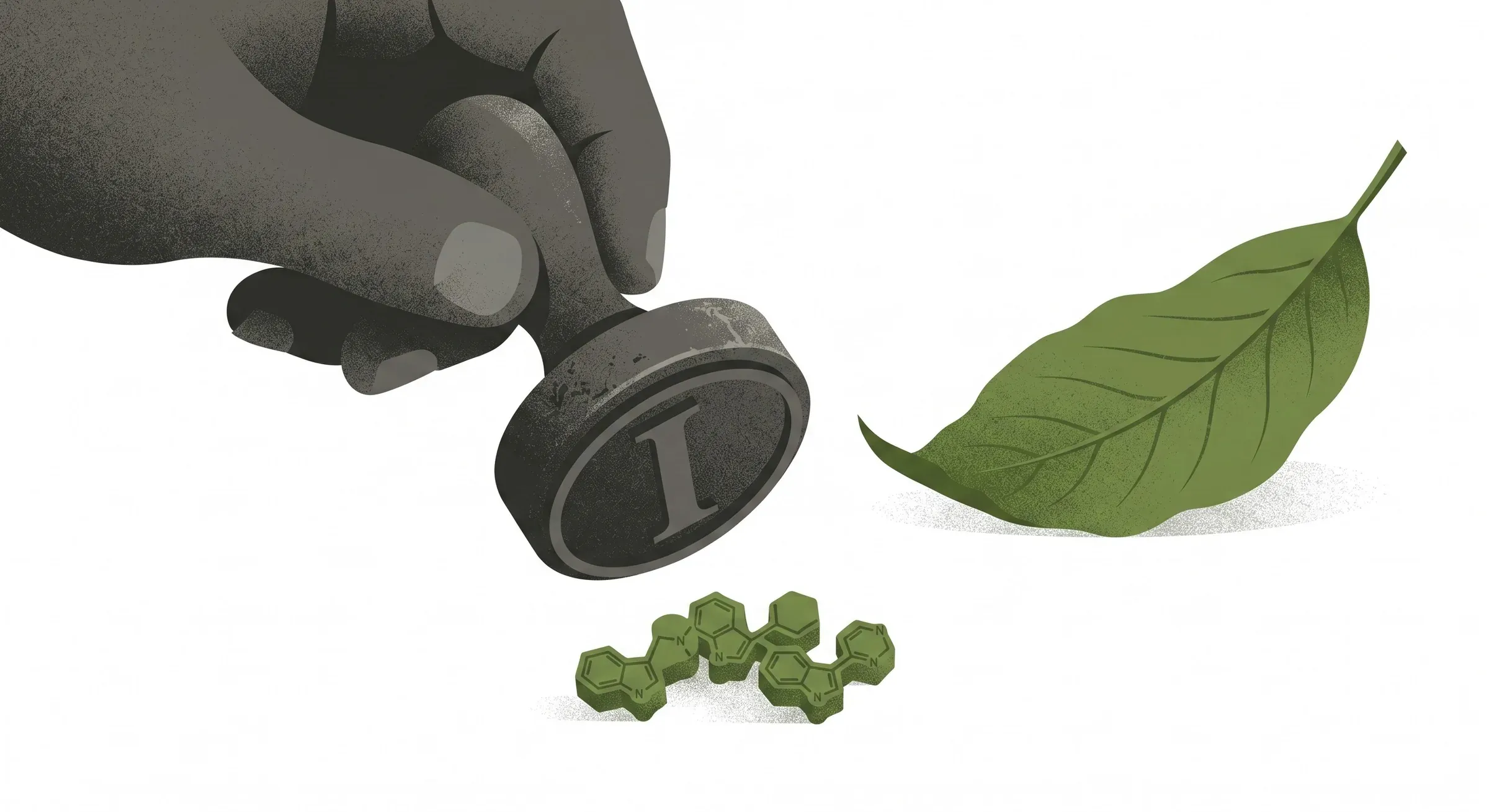
The Drug Enforcement Administration placed three kratom-derived opioids in Schedule I of the Controlled Substances Act on 26 August 2026. They are mitragynine pseudoindoxyl, MGM-15 and MGM-16, and they are the first substances derived from kratom ever to be federally controlled in the United States.
The order is temporary. It runs to 26 August 2028, and the DEA may extend it by one further year if proceedings to schedule the substances permanently are started in the meantime. The agency says it will publish a further document if the listing is extended or made permanent.
Kratom was not scheduled by this order. Neither was mitragynine, and neither was 7-hydroxymitragynine. The amendatory text adds three named compounds at 21 CFR § 1308.11(h)(89) to (91), under DEA codes 9672, 9673 and 9674. It lists nothing else.
What the three substances are
None of them is something a kratom plant produces.
The DEA’s finding is explicit on this point. Mitragynine and 7-hydroxymitragynine, it says, are “naturally occurring in the plant”, while mitragynine pseudoindoxyl, MGM-15 and MGM-16 “are produced through synthetic modifications of purified mitragynine isolates or 7-hydroxymitragynine”.
- Mitragynine pseudoindoxyl is a chemical rearrangement product of 7-OH. It was first described in 1974, isolated as a metabolite of biotransformed mitragynine.
- MGM-15 is dihydro-7-hydroxymitragynine.
- MGM-16 is 9-fluoro-dihydro-7-hydroxymitragynine. The fluorine atom is the giveaway: plants do not fluorinate their own alkaloids.
MGM-15 and MGM-16 were made in 2014 in a drug-discovery programme looking for opioid analgesics.
MGM-16 has not been found in any product. The order says so in terms: “While no evidence supports the presence of MGM-16 on the Mitragyna speciosa consumer market”. It was scheduled anyway, and the DEA’s reasoning is worth reading, because it is a pre-emptive act rather than a response to harm. MGM-16 is more potent than MGM-15, structurally close to it, and the agency found a vendor site listing it for upcoming sale. To control MGM-15 alone, it argues, “would create a regulatory loophole that manufacturers are already poised to exploit”.
So of the three, two moved from the laboratory to shops and one has not moved yet.
The listing covers each substance’s isomers, esters, ethers and salts, which is the standard formula and is what stops a one-atom change from escaping the order.
Why the DEA says it acted
Temporary scheduling under 21 U.S.C. 811(h) needs a finding that control is “necessary to avoid an imminent hazard to public safety”, made on three of the eight statutory factors: the history and pattern of abuse, its scope and significance, and the risk to public health.
The agency reports that all three bind the mu-opioid receptor and act as agonists at it, and that preclinical studies show analgesic effects more potent than morphine. That is animal and in-vitro work, and the order does not claim otherwise.
On what has actually happened to people, the order gives two kinds of number and they are not the same kind of evidence.
Detections in overdose cases. The DEA’s own toxicology surveillance programme identified mitragynine pseudoindoxyl in at least 56 overdose cases between February 2025 and May 2026, 48 of them fatal, and MGM-15 in 17 cases between February and April 2026, 16 of them fatal. Read that as detection. A substance found in a sample is not a substance shown to have caused the death, and the order does not say it was. The CDC report cited below found that multiple substances were involved in 184 of 233 kratom-associated deaths, so co-exposure is the norm in this record rather than the exception.
Poison centre calls about kratom generally. Citing a CDC report published this year, the order records a rise in kratom-related calls to United States poison centres from 258 in 2015 to 3,434 in 2025, and 14,449 reports over eleven years. Those are calls about kratom, not about these three compounds, and a call is a call rather than a poisoning.
What is being sold
The order describes a market that has moved a long way from the leaf.
Mitragynine pseudoindoxyl was first confirmed in consumer products in 2024; MGM-15 appeared in commercial products in September 2025. Both are sold as powders, tablets and liquid shots, online and in petrol stations, corner shops and vape shops.
A study of 51 products sold online as mitragynine pseudoindoxyl found 39 were chewable tablets, 35 carried flavourings (berry, mint, watermelon, pink lemonade, candy apple, grape, citrus, mango, pistachio, vanilla), and 32 used brightly coloured packaging. Two were dried ice cream cones and one was a chocolate bar. Many, the order says, had serving sizes requiring the buyer to split a tablet or a dose.
The order separately reports that 71 per cent of products sampled contained mitragynine pseudoindoxyl together with 7-hydroxymitragynine, 24 per cent contained it alone, and the remaining 6 per cent combined it with 8- or 11-hydroxymitragynine, with alkaloid concentrations often higher than in the leaf. We report those figures as the order’s, and with a caveat: the footnote it hangs them on is a 2021 mouse study of physical dependence, which cannot be where a survey of retail products came from. We could not identify the actual source.
The DEA notes that these products are commonly advertised as “botanical extracts” or “mood boosters”, and are also often labelled as sold for laboratory or research purposes and “not intended for human consumption”. Its view is that the botanical framing “creates a false sense of safety”.
We note the obvious consequence for a reader rather than for a regulator. A product sold under kratom’s name, from a kratom shelf, may contain a semisynthetic opioid that no kratom plant produces, and the label is not a reliable guide to which.
What has not happened
This is the part most easily got wrong, because two DEA documents published on the same day in July have since gone in opposite directions.
91 FR 40909 was the notice of intent covering these three substances. It is the one that has now issued as the order described above.
91 FR 40917, the separate proposal to schedule 7-hydroxymitragynine itself, remains a Proposed Rule. No order has issued on it and it has no effective date. Nothing about 7-OH’s federal status changed on 26 August.
Its threshold has two limbs and they are not the same test. Botanical material of Mitragyna speciosa is caught where it contains more than 0.050 per cent 7-OH on a dry weight basis. Anything else, meaning synthetic material or material processed into extracts, concentrates, edibles or pressed pills, is caught above 0.050 per cent by weight or volume or above 1.00 mg of 7-OH in the article. The milligram limb applies only to that second class.
The Department of Health and Human Services extended the comment period on its request for information about that threshold on 26 August. Comments had closed on 31 July; they now run to 10 September 2026. HHS granted the extension after a request for one, and says it is not seeking comment on permanent scheduling, on the general safety or utility of kratom-derived products, or on anything else outside the threshold question.
We also cover the 6 July notices here, including the claim, repeated widely and not supported by the text, that botanical leaf is categorically exempt from the 7-OH proposal.
What it means in practice
From 26 August 2026, anyone who possesses, manufactures, distributes, imports, exports or does research with the three substances needs a DEA registration, and the administrative, civil and criminal consequences that attach to a Schedule I substance apply. A researcher already registered for another Schedule I substance may carry on if an application to add these is filed within 90 days.
One thing to be aware of if you go looking. We checked the codified text of § 1308.11 on the eCFR on 27 August, and it was current only to 25 August 2026, which is the day before the order took effect. The three new paragraphs were therefore not in it. The order is law from its effective date whether or not the codification has caught up.
Our reading of United States federal law is at /legal/united-states/.