
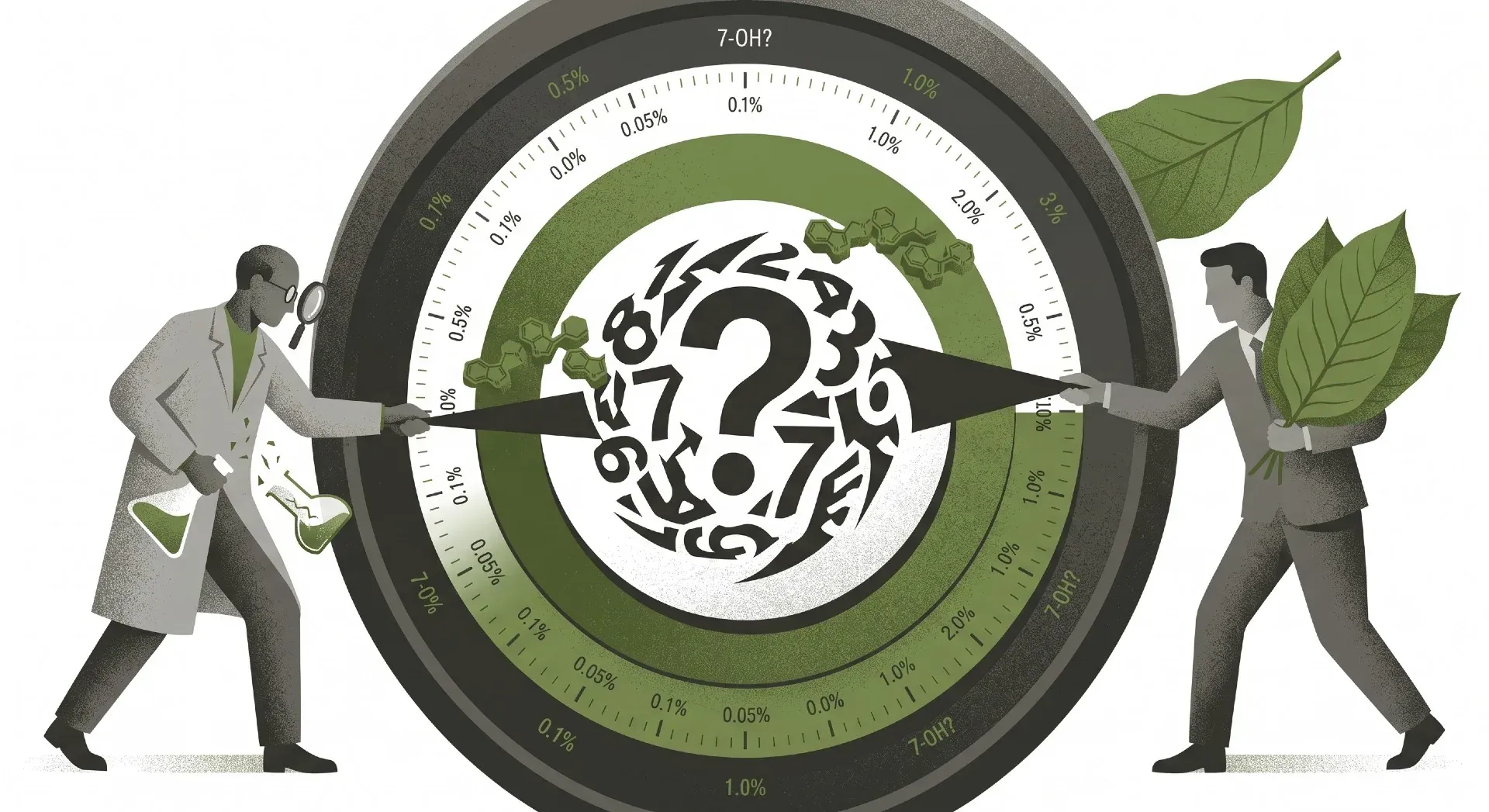
The United States is not deciding whether to ban kratom. It is deciding where to put a number. The three federal documents that deal with 7-hydroxymitragynine as such, all filed on 6 July 2026, turn on a single concentration figure of 0.050 percent and on which side of it a given product falls.
The number is still not fixed. The Drug Enforcement Administration said in July that the temporary scheduling order “will be published in the Federal Register on or after August 5, 2026”. As of 31 August it had not been. The Department of Health and Human Services, which supplied the threshold in the first place, is still taking comment on it, and that comment period now closes on 10 September 2026.
This page sets out the axis the argument runs along, because the axis is easy to lose in summaries of it.
What the proposed control actually covers
The notice of intent published at 91 FR 40917 proposes to schedule 7-hydroxymitragynine “above a specified threshold, including its isomers, esters, ethers, salts, and salts of isomers, esters, and ethers”. The qualifier is doing the work. Nothing is controlled at any concentration. What is controlled is material in which 7-OH exceeds a set amount.
The definition as printed in the notice’s supplementary information:
(A) Any botanical material of the plant Mitragyna speciosa, also known as kratom, and contains more than 0.050 percentage of 7-hydroxymitragynine on a dry weight basis, or
(B) Any alternative article to that described in (A), that is:
i. Resulting from synthetic methods and containing 7-hydroxymitragynine present in amounts greater than 0.050 percentage by weight/weight, weight/volume, or volume/volume or greater than 1.00 milligram of 7-hydroxymitragynine in the article, or
ii. Material derived from Mitragyna speciosa and further processed to manufacture alternative dosage forms such as extracts, concentrates, processed edibles, or pressed pills, and which may have materials that have been exposed to chemical, thermal, or other methods leading to chemical transformations that result in 7-hydroxymitragynine present in amounts greater than 0.050 percentage by weight/weight, weight/volume, or volume/volume, or greater than 1.00 milligram of 7-hydroxymitragynine in the article.
Three things follow from reading that rather than a summary of it.
The definition opens with botanical material. Limb (A) is about the plant. Kratom leaf is inside the scope of the proposal and always was. It sits outside the control only by falling below a number, which is a fact about a particular batch rather than a property of the species.
Limb (B)(ii) reaches processing, and it names heat. It applies to material “further processed to manufacture alternative dosage forms such as extracts, concentrates, processed edibles, or pressed pills” where “chemical, thermal, or other methods” have led to chemical transformations that result in 7-OH above the threshold. Note the limits of that. The clause is about manufacturing another dosage form, so plain dried leaf is not in it. Plain leaf is governed by limb (A) and its dry-weight test.
Both parts of limb (B) also carry a second, absolute figure that limb (A) does not. Material containing more than 1.00 milligram of 7-OH “in the article” is caught regardless of concentration. A pressed pill can sit under 0.050 percent by weight and still be within the proposal on that basis alone. Botanical material under limb (A) has no milligram alternative at all, which is the part a reader holding plain leaf actually needs.
The molecule is the same in a leaf and in a tablet
The DEA’s own notice states this plainly, and the passage removes an argument made on both sides of the dispute.
Despite the different origins of 7-hydroxymitragynine, the chemical structures of synthetic and naturally occurring 7-hydroxymitragynine are identical. Consequently, the intrinsic pharmacological profile, receptor affinity, and mechanism of action of 7-hydroxymitragynine molecule remain unchanged regardless of its source.
So “natural” does not describe a different substance. The notice records that 7-OH can be made from mitragynine “through a one-step chemical reaction”, and that it also arises as an oxidised metabolite of mitragynine inside the body. Our own summary of the pharmacology, including the 2019 finding that human and mouse liver preparations convert mitragynine into 7-OH, is on what mitragynine and 7-OH are and what they do.
If the molecule is the same, the line has to be drawn somewhere else. The notice draws it at dose and matrix:
While consumers of raw plant matrix may experience a modified or attenuated physiological effect due to the competitive, co-occurring alkaloids inherent to M.speciosa, isolated or semi-synthetically derived formulations deliver unattenuated, high-potency effects of the target alkaloid directly, representing a distinct public safety profile when concentrated above the proposed threshold.
That is the core of the government’s case, and it is a pharmacological claim rather than a legal one.
It is worth being clear about what supports it. The two paragraphs of the notice that describe 7-OH’s origins, abundance and matrix effects carry no footnotes at all. The first reference in that discussion, numbered 15, attaches to a later sentence about abuse potential and cites a 2019 preclinical study by Hemby and colleagues in Addiction Biology. Everything quoted above sits in the uncited passage, and that includes the abundance figure used in the next section of this page. Read all of it as the agency’s position, which is what it is, rather than as findings with references behind them.
The notice’s own two numbers do not share a denominator
Here is a detail that matters for anyone trying to work out whether ordinary leaf falls under the line.
The notice describes natural abundance this way: in its natural botanical form, 7-OH “makes up less than two percent of the total alkaloid content or occurs in trace amount”. The denominator there is total alkaloid content.
The threshold in limb (A) is 0.050 percent “on a dry weight basis”. The denominator there is the dry weight of the whole material, which is mostly not alkaloid.
Those are two different fractions of two different quantities, and one cannot be compared with the other without knowing the total alkaloid content of the specific material being tested. The notice does not supply that figure. So the document does not, on its own terms, establish where any given lot of leaf sits relative to its own threshold. That is a laboratory question about a sample, which is precisely how the proposal is drafted.
Why “leaf is exempt” is the wrong reading
The claim that botanical kratom is carved out of the proposal is common in coverage of it. There is no exemption clause in the notice. The word “exempt” appears once in the whole document, in the statutory precondition that there be “no exemption or approval in effect for the substance under section 505 of the Federal Food, Drug, and Cosmetic Act”. That is a condition on the DEA’s power, not a carve-out for leaf. We set that out when the notices were filed and nothing since has changed it.
The practical effect for most plain leaf is close to what sellers describe, because most plain leaf is well below the threshold. The reasoning is not the same, and the difference is what a reader can act on. An exemption would be a statement about kratom. A threshold is a statement about a sample. Under a threshold, a product marketed as botanical is controlled if its assay comes back above the line, and no label or category name changes that.
Where the number came from
The DEA did not invent 0.050 percent. The notice records that the threshold “was adapted from the definition used by the Department of Health and Human Services”, set out in a letter of 28 July 2025 that transmitted the department’s scientific and medical evaluation to the DEA under 21 U.S.C. 811(b) and (c).
That is why the live consultation is being run by HHS rather than by the DEA, and why its scope is so narrow. The extension notice published on 26 August says the department “is not soliciting comments on any permanent scheduling decision, the general safety or utility of kratom-derived products, or other policy questions outside the scope of the threshold determination for temporary scheduling.”
The single federal question open to public input right now is where the number goes. Comments close on 10 September 2026, in docket HHS-OASH-2026-0232.
What has happened, and what has not
Keeping these apart is the whole of accurate coverage on this beat.
Proposed and still pending. The 7-OH threshold. Notice of intent filed 6 July 2026, earliest order date 5 August 2026, no order published as of 31 August 2026.
In force. Three related compounds, and only those three. Mitragynine pseudoindoxyl, MGM-15 and MGM-16 entered Schedule I by temporary order on 26 August 2026, and we covered that order separately. The DEA calls them 7-hydroxymitragynine-related substances and distinguishes them from the plant’s own alkaloids: “Unlike the indole alkaloids mitragynine and 7-hydroxymitragynine, which are naturally occurring in the plant”, the three “are produced through synthetic modifications of purified mitragynine isolates or 7-hydroxymitragynine”. Kratom, mitragynine and 7-OH itself remain uncontrolled at federal level. Those two documents contain no threshold and no 0.050 figure anywhere.
Separate, and stricter. State law. Massachusetts placed kratom in its own Schedule I by emergency regulation, 105 CMR 726.000, effective 28 August 2026 and in force for one year. Its definition names the plant, mitragynine, 7-OH and the three synthetic derivatives, with no concentration limit anywhere in it. A federal threshold does not constrain a state either way, and the notice says so: the DEA’s action “does not preempt more restrictive state law”. Our United States page tracks both levels.
Under 21 U.S.C. 811(h) a temporary order lasts two years and can be extended by one further year while permanent scheduling is pursued. The route is fast by design. In the notice’s own description of its authority, the DEA may act “without regard to the requirements of 21 U.S.C. 811(b)”, the provision that brings in the HHS scientific and medical evaluation, and it acts by order rather than by rule. The only timing constraint is that no such order may issue until 30 days after both the notice of intent is published and notice is transmitted to the Assistant Secretary of HHS.
What is not known
The notice is candid about the gap, and it deserves to be quoted rather than paraphrased: the safety profile of concentrated products in humans “remains unknown because no controlled clinical trials have been conducted to establish safe consumption limits or standardized dosing.”
That absence cuts in both directions. It is not evidence that concentrated 7-OH products are safe, and it is not evidence that they are as dangerous as the strongest claims made about them. The evidence the notice does assemble is preclinical work, poison-centre exposure data, FDA warning letters, state legislation and observation of the online market. What it does not have is a controlled human trial, and it says so.
For readers in Europe
None of this has legal effect in Europe, and it changes nothing about what is lawful today in any European country.
It is worth saying what this action is not, because the inference is easy to draw and we cannot support it. European control of kratom did not follow the United States and could not have: no US federal scheduling of kratom, mitragynine or 7-OH has ever taken effect. Denmark, Finland and Sweden each acted under their own national instruments, and we read those instruments on the country pages rather than reasoning from Washington.
Kratom’s status in Europe is set by national law and varies widely. We read each country’s own instruments and record what they say on our legal status tracker.